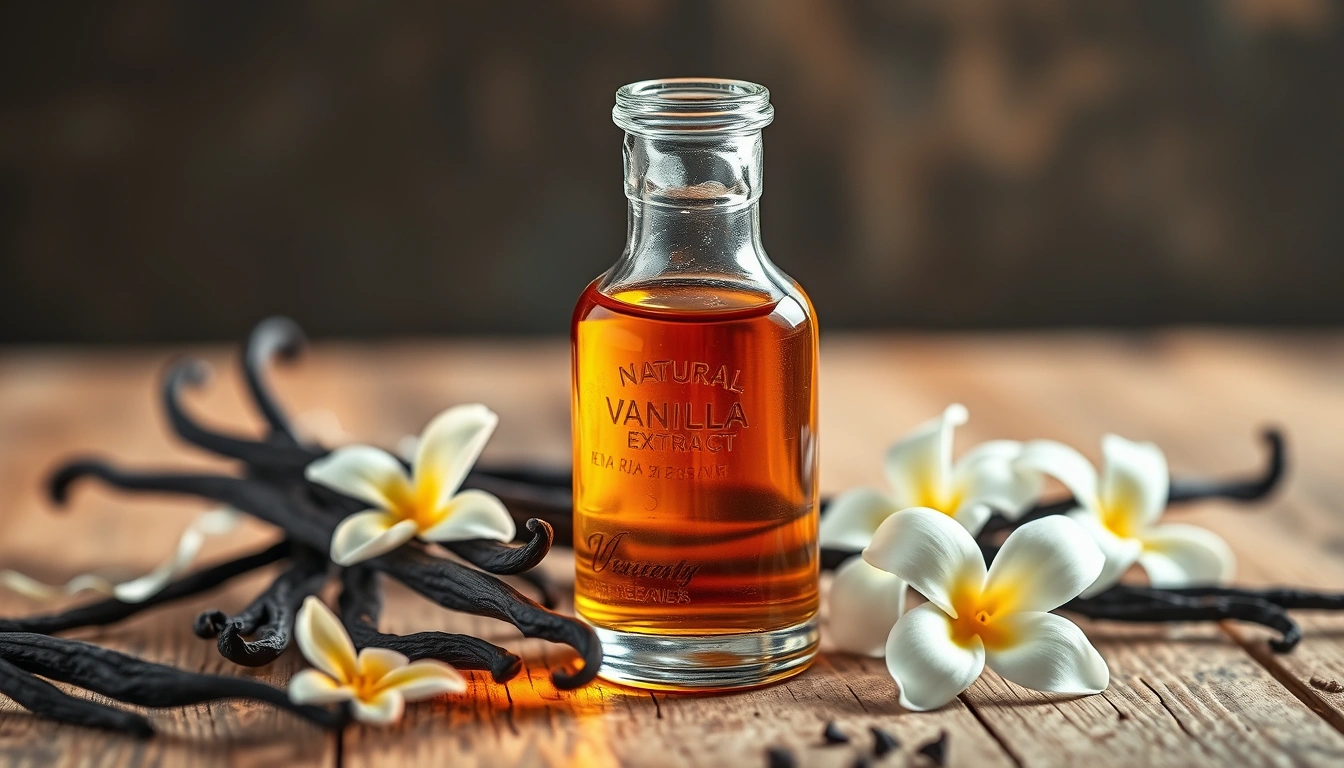
Vanilla extract
288 kcal per 100 g
Category: Sweets and Sweeteners
Nutritional information (per 100 g)
| Calories | 288 kcal |
| Protein | 0.1g |
| Carbohydrates | 12.7g |
| Sugars | 0g |
| Total fats | 13g |
| Saturated fats | 8.8g |
| Fiber | 0g |
| Sodium | 16mg |
Vitamins and minerals
Description
Vanilla extract is a liquid ingredient obtained from the maceration and extraction of vanilla beans in an alcohol base, which concentrates its characteristic sweet, floral, and slightly creamy aroma. It is widely used in baking and dessert making to provide a deep and aromatic flavor that enhances preparations such as cakes, cookies, ice cream, custards, and other sweets.
The origin of vanilla extract dates back to Mesoamerica, where pre-Columbian civilizations, such as the Totonacs and Aztecs, were the first to cultivate and use the pods of Vanilla planifolia. Currently, the main producers of vanilla are Madagascar, Indonesia, and Mexico, the latter country being recognized as the birthplace of vanilla.
Regarding its properties, vanilla extract not only adds flavor but also contains antioxidant compounds and small amounts of minerals, although its primary function in cooking is as a flavoring. It is important to use it in moderate amounts due to its intense concentrated flavor.
In the Spanish-speaking world, in addition to "extracto de vainilla," it is commonly referred to as esencia de vainilla or estracto de vainilla (the latter being a less formal and more colloquial form), although the essence is usually a more artificial and less pure mixture than natural extract. In some countries, when "vainilla" is mentioned in a recipe, it is understood that it could be extract or essence, depending on the context and the desired quality.