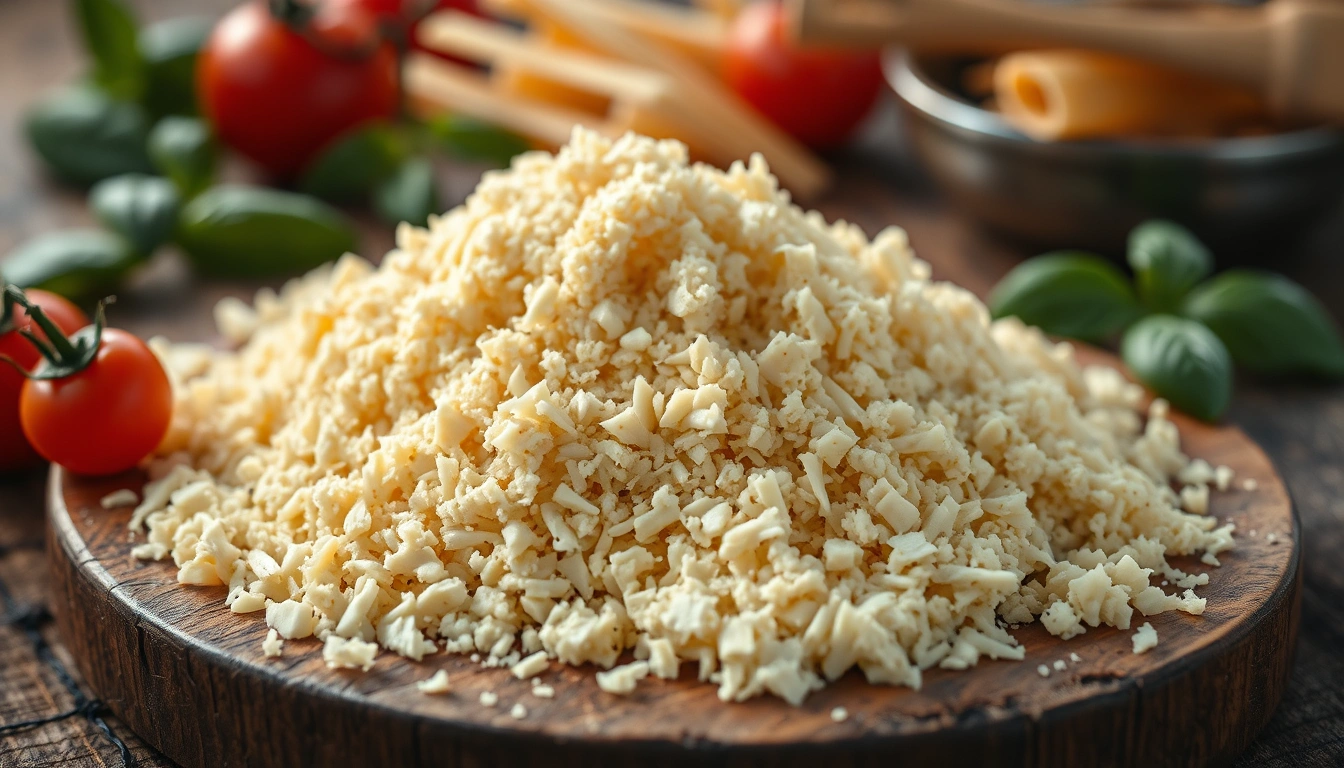
Parmesan and romano cheese blend
431 kcal per 100 g
Category: Dairy
Nutritional information (per 100 g)
| Calories | 431 kcal |
| Protein | 38g |
| Carbohydrates | 3.2g |
| Total fats | 29g |
| Saturated fats | 18g |
| Fiber | 0g |
| Sodium | 1500mg |
Vitamins and minerals
Description
Parmesan and Romano cheese blend
The Parmesan and Romano cheese blend is a classic combination used in cooking to provide an intense, salty, and umami flavor to numerous dishes, especially in pastas, salads, soups, and gratins. These two cheeses, although similar, possess distinctive characteristics that enrich the flavor profile of the blend.
Food description:
Parmesan cheese (Parmigiano-Reggiano) is a hard, granular cheese originating from the Emilia-Romagna region in Italy. It has a robust, slightly fruity flavor and a crumbly texture. Romano cheese (Pecorino Romano), on the other hand, is a hard cheese made from sheep's milk, with a stronger, saltier, and sharper flavor than Parmesan.
Origin:
Both cheeses originate from Italy, being fundamental pillars of its gastronomic tradition. Parmesan comes from the provinces of Parma, Reggio Emilia, Modena, and parts of Mantua and Bologna, while Romano is typical of Lazio, Tuscany, and Sardinia.
Properties:
This blend provides an excellent source of protein, calcium, and phosphorus. Furthermore, both cheeses are rich in fats and sodium, so moderate consumption is recommended. When blended, they achieve an ideal balance of flavor, texture, and salinity to enhance any recipe.
Synonyms in Latin American Spanish:
In different Latin American countries, these cheeses may be known simply as queso parmesano or queso romano. In some places, Romano cheese is also identified as queso pecorino, especially when it is made from sheep's milk. The blend is commonly referred to as mezcla de quesos duros italianos (Italian hard cheese blend) or mezcla de quesos para pasta (pasta cheese blend).