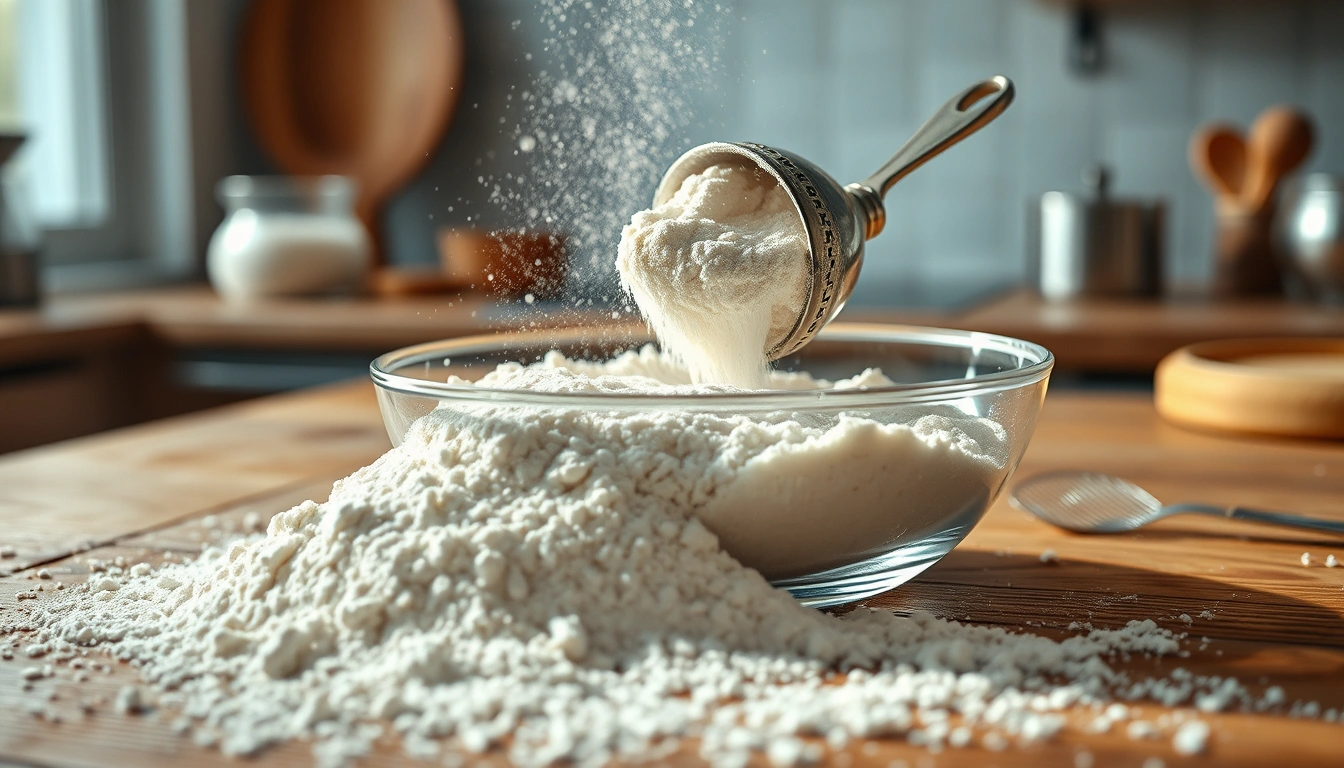
Self-raising flour
360 kcal per 100 g
Category: Cereals and Grains
Nutritional information (per 100 g)
| Calories | 360 kcal |
| Protein | 8g |
| Carbohydrates | 76g |
| Sugars | 0.3g |
| Total fats | 1.5g |
| Fiber | 2.7g |
| Sodium | 900mg |
Vitamins and minerals
Description
Self-rising flour is a mixture of wheat flour along with leavening agents, commonly baking powder, which allows doughs to have better rising and fluffiness without the need to add additional yeast. It is widely used in recipes for quick baking and pastries, such as spongecakes, pound cakes, muffins, and layer cakes, where a light and airy texture is required.
Its origin is linked to the need to simplify the preparation of fluffy doughs, avoiding the long process of rising with traditional yeast. This flour is very popular in Spanish-speaking countries and is produced by combining refined white flour with an adequate amount of leavening powders and, sometimes, a touch of salt to enhance the flavor.
Among its properties, its ability to release carbon dioxide upon contact with liquids and heat stands out, which causes the expansion of air bubbles in the dough and, therefore, a greater volume and a softer texture. It is ideal for quick and practical preparations.
Regarding synonyms and equivalent terms in the Hispanic world, self-rising flour is also known as:
- Prepared flour
- Flour with baking powder
- Cake flour (in some countries)
- Flour with chemical yeast
It is important not to confuse it with all-purpose flour (wheat flour without leavening agents) nor with bread flour with incorporated yeast, as self-rising flour is designed to work without additional fermentation.