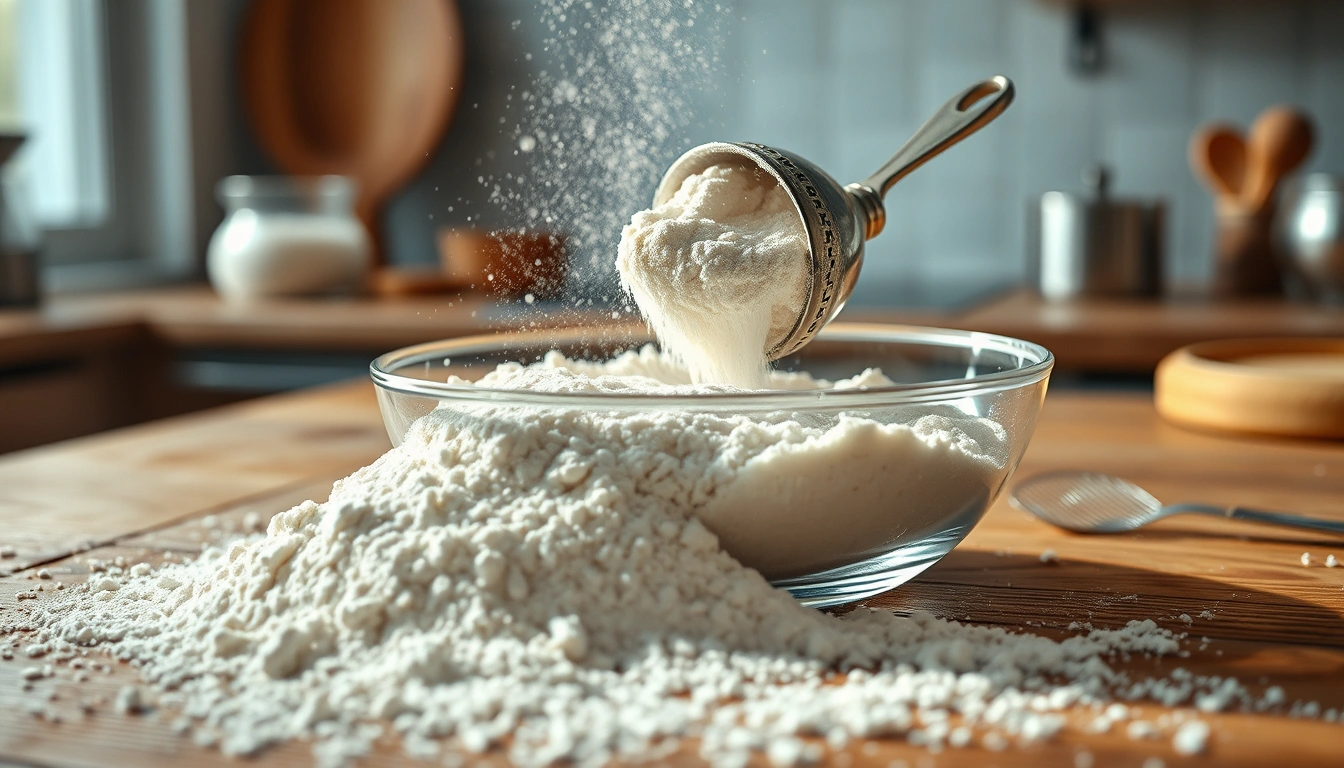
Self-raising flour
364 kcal per 100 g
Category: Cereals and Grains
Nutritional information (per 100 g)
| Calories | 364 kcal |
| Protein | 8g |
| Carbohydrates | 76g |
| Sugars | 0.3g |
| Total fats | 1g |
| Saturated fats | 0.2g |
| Fiber | 2.7g |
| Sodium | 1200mg |
Vitamins and minerals
Description
Self-raising flour is a type of wheat flour that contains incorporated leavening agents, such as baking powder, which allows doughs to rise and become fluffy without the need to add yeast separately. It is an essential ingredient in quick baking and pastry recipes, ideal for preparing cakes, sponges, muffins, and pancakes with a light and airy texture.
Its origin dates back to the evolution of home and commercial baking, where the goal was to simplify the preparation of fluffy doughs by incorporating the chemical leavening agent directly into the flour, ensuring consistent results and avoiding errors in measuring baking powder.
Regarding its properties, self-raising flour combines the structural function of wheat flour with the ability of leavening agents to release carbon dioxide upon contact with liquids and heat, causing the dough to rise. This facilitates preparation and improves the final texture of baked goods.
In different Latin American countries, self-raising flour may be known by different synonyms such as:
- Prepared flour
- Flour with baking powder
- Pastry flour (in some contexts)
It is important to clarify that it should not be confused with all-purpose flour nor with bread flour, as its specific composition makes it ideal for recipes that require quick and uniform chemical leavening.